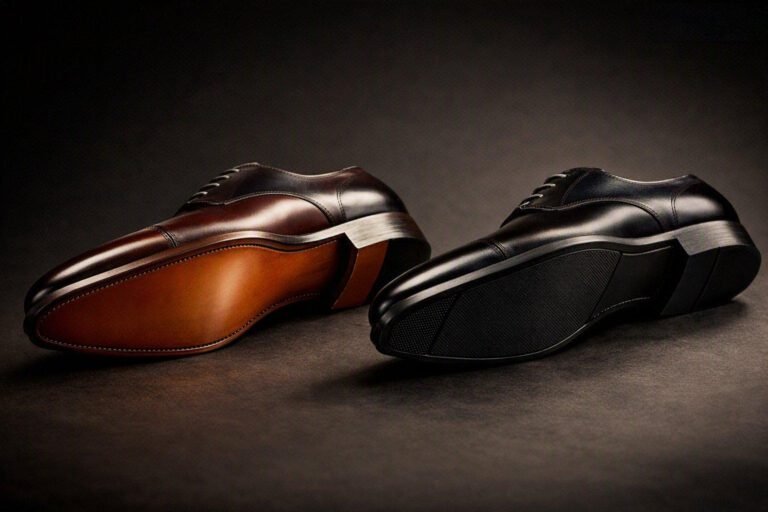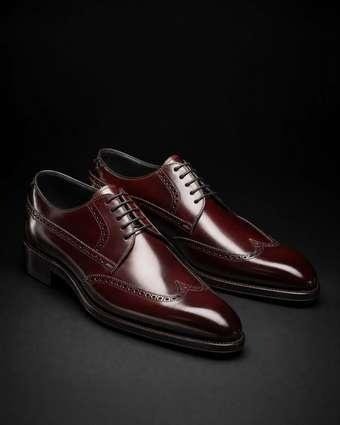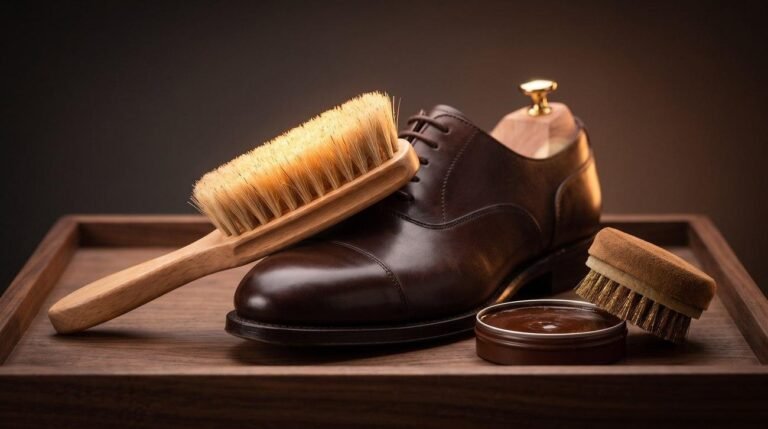
If you invest in proper leather shoes or western boots, cedar shoe trees aren’t optional; they’re part of the cost of ownership. Inserted soon after wear, an unfinished wooden tree quietly manages the two forces that ruin shoes fastest: trapped moisture and uncontrolled creasing. Used consistently, they keep the toe from curling, the heel counter from collapsing, and the vamp from turning into deep wrinkles that eventually crack. Store shoes without them and the damage shows first at the toe box, vamp, and heel, where the leather and lining absorb the most stress.
What Shoe Trees Do, and Why They Matter
Leather stretches, compresses, and absorbs perspiration with every step. If you insert trees while the leather is still warm, roughly within 20 to 30 minutes, the fibers relax back toward their intended shape before they cool and set distorted. The other job is moisture. Feet can produce around half a cup of perspiration a day, and if that moisture stagnates it fuels bacterial and mold growth, degrades stitching, and breaks down linings. An unfinished wooden tree draws perspiration out of the lining and lets it evaporate gradually rather than soaking the leather overnight.
What trees can’t do matters just as much: they won’t reverse deep, long-set creases or replace conditioning and cobbler work, and they only deliver when sized correctly and used every time. If you’re starting a new pair from scratch, this fits into your broader first-day care ritual.
For the full new-shoe routine, see our The Comprehensive Dress Shoe Width Guide
Are Cedar Shoe Trees the Best Choice?
Aromatic red cedar, Eastern red cedar, technically a juniper, is the dominant shoe-tree material in North America because it’s abundant, easy to work, and genuinely useful: a porous structure that pulls moisture from the lining, plus natural oils long associated with odor control. The honest counter-argument, common among European makers, is that cedar’s dominance is partly supply-and-marketing driven. Denser hardwoods, beech, lime, maple, are more durable and hold shape beautifully, though they lack cedar’s odor-control edge. In practice: cedar for daily use where moisture and odor matter most; beech and maple for high-end and bespoke pairs where long-term stability and finish lead.
Cedar Versus Other Woods
Premium cedar trees typically specify 75%+ heartwood, the active, aromatic portion, and leave the wood unfinished, because varnish or lacquer seals the pores and effectively eliminates absorption. Light sanding every 12 to 18 months removes the glazed outer layer and restores both absorbency and aroma; with that upkeep a cedar tree can realistically last a lifetime.
Beech is the preferred wood for many high-end European trees: dense, fine-grained, dimensionally stable, with slightly less aggressive moisture absorption than cedar. The Arterton Luxury Beechwood tree is a leading example, finished with carnauba wax that preserves permeability while giving the wood a refined look. Maple appears in some bespoke, lasted trees where precision matters most; alder is a lighter alternative with good behavior; softwoods like pine and poplar occupy the entry tier with modest performance.
Wood Versus Plastic, Foam, and Synthetic
Wooden trees do two things plastics can’t: hold the shoe’s architecture and actively manage moisture. Plastic trees are light and cheap and fine for travel, where crushing is the real risk, but for daily use they’re counterproductive, absorbing no moisture and trapping perspiration in exactly the warm, damp conditions bacteria thrive in. Foam and fabric forms offer minimal shape retention and no moisture management; treat them as packing material. Spring-loaded wire “spiral” trees concentrate tension on a small heel knob and can permanently deform the heel counter of a good shoe. Metal boot inserts support tall shafts well but still need a proper wooden tree in the foot if you care about moisture and creasing.
Key Design Features
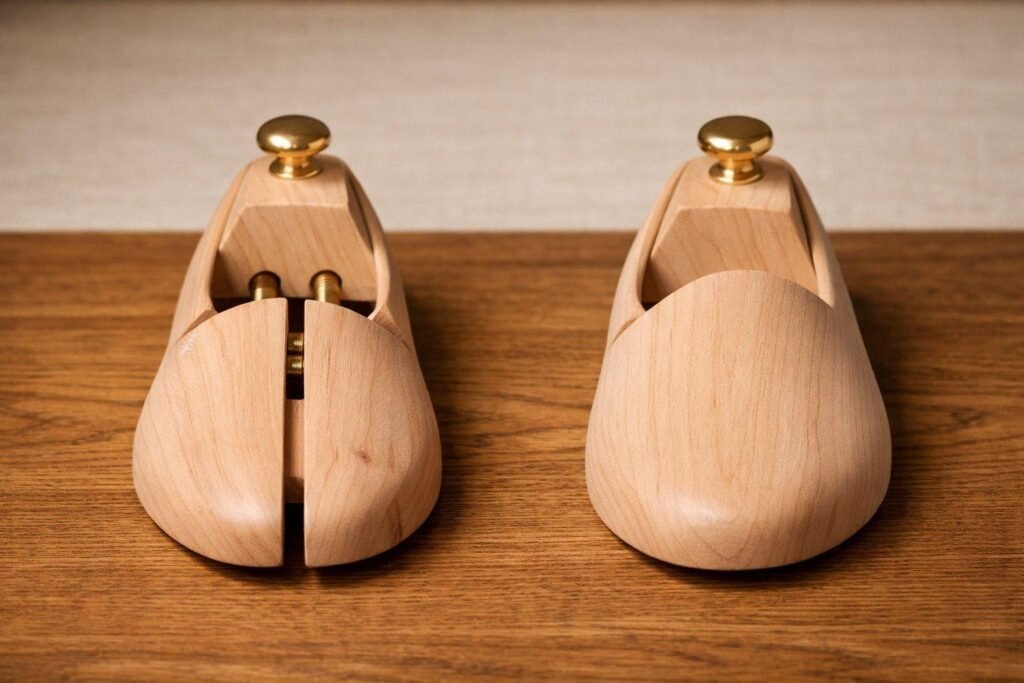
Split-toe (left) adjusts to the shoe’s width; solid-toe (right) gives uniform support but needs a matched last.
Split-toe trees divide the forepart and use an internal spring so the toe compresses on insertion and then expands to fill the shoe’s width. That adjustability makes them the most versatile choice for off-the-rack footwear and the right call for most formal shoes and many boots. Solid-toe trees give uniform vamp support but little width flexibility, so they suit a specific last or bespoke pairs. Whatever the design, a proper tree needs a full, contoured heel block that spreads tension evenly; narrow heel pegs concentrate pressure and slowly distort the counter.
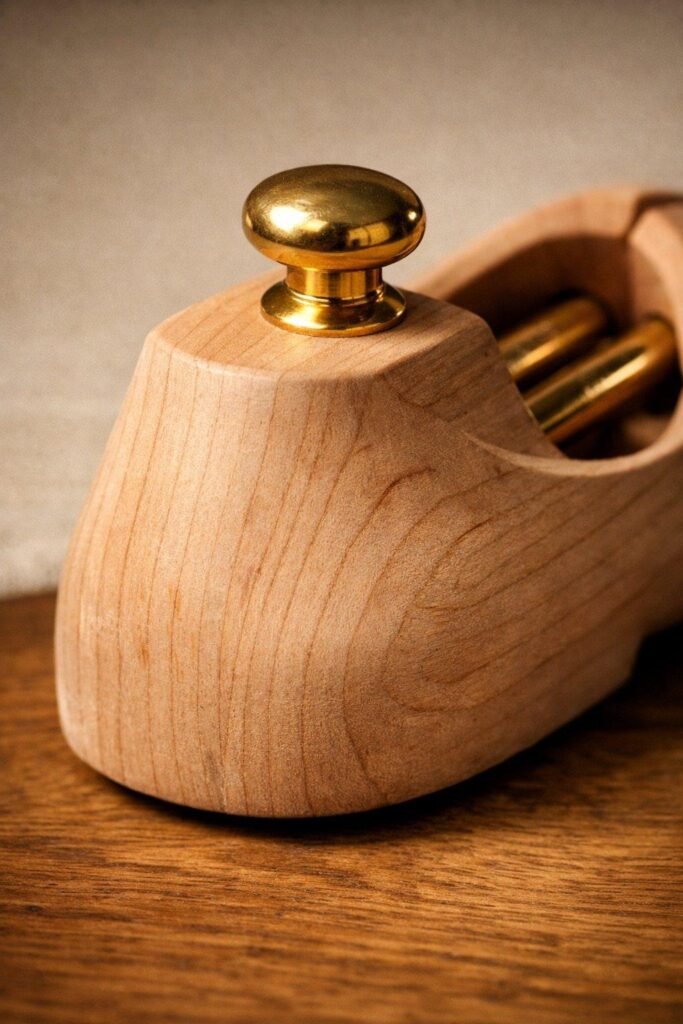
Twin brass tubes distribute tension evenly across the vamp, more stable than single-tube designs on wider lasts.
Twin-tube designs connect toe and heel with two parallel plungers for better lateral stability; single-tube trees are reliable but allow more movement in wider shoes. Lasted trees, carved from the shoe’s own last, remain the gold standard but are pair-specific.
Specialized Trees for Boots and Westerns
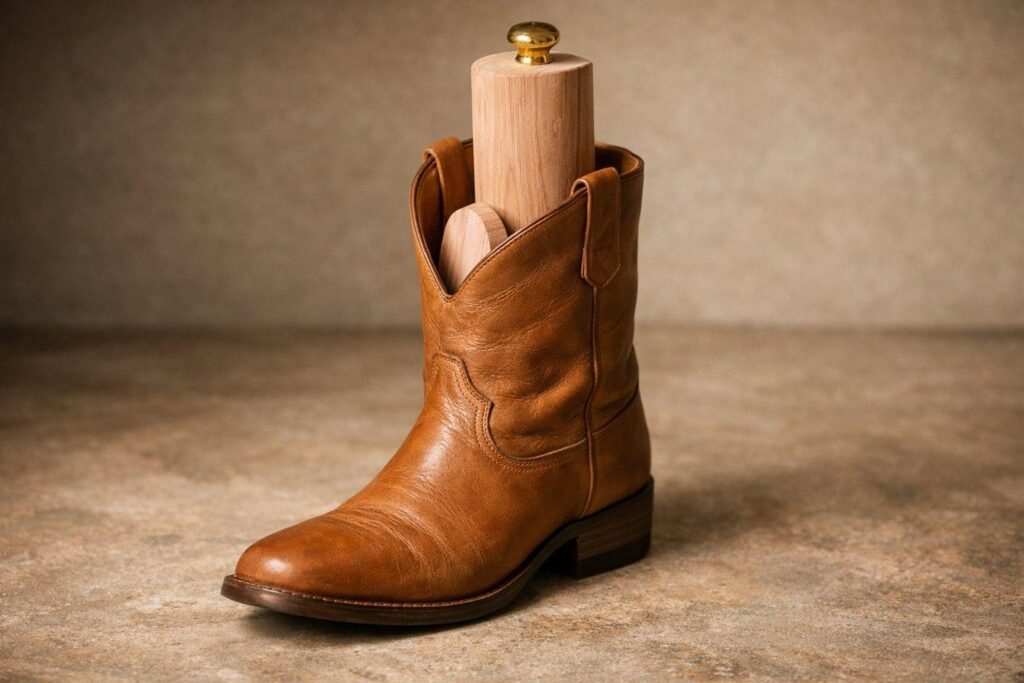
Tall boots need shaft support: a cedar foot tree plus a shaft shaper keeps the leg from folding and creasing at the ankle.
Most ankle boots, Chelseas, chukkas, dress boots, are well served by standard cedar trees; they lack tall shafts and mainly need moisture management and basic vamp control. Boot trees with an extended vamp profile are built for engineer, service, and heavy-duty work boots, filling the higher instep a regular tree leaves unsupported. Tall western, cowboy, and riding boots add a shaft problem: unsupported, the leg flops, creases at the ankle, and loses shape. The ideal setup is a cedar foot tree plus a cedar shaft shaper; HOUNDSBAY’s combined boot tree and shaft shaper is built explicitly for that geometry.
How to Choose the Right Size and Fit
A correctly sized tree needs mild compression of the center spring to insert; never force. Seated, the heel block should rest flush against the counter, the toe block should fill the vamp without lifting off the insole, and side tension should feel firm and even. If the upper puckers or seams pull, the tree is too wide; if the vamp sags, it’s too narrow. Choose your exact shoe size where possible, size down on half sizes, and treat width as seriously as length. Split-toe trees are safer for pointed toes because they compress into a narrow box, and you should always check the maker’s chart; Woodlore runs slightly small, and brand-specific trees like Allen Edmonds’ are sized to particular lasts.
Product Picks
Three picks below carry Amazon links; the two premium picks are editorial recommendations we don’t earn on, included on merit.
Woodlore Epic Twin-Tube, Best Overall
The dependable all-rounder for dress shoes and everyday leather. Aromatic red cedar with 75%+ heartwood, a split-toe forepart, twin brass-plated tubes, and a full contoured heel, around $38 a pair. The twin-tube hardware gives better lateral stability than single-tube designs, which helps on wider lasts. Sizing runs slightly small; follow Woodlore’s chart rather than assuming your street size. Note it’s made overseas, not in the USA. Shop the Woodlore Epic Twin-Tube on Amazon
Stratton Adjustable Split-Toe Cedar, Best Value
USA-grown aromatic red cedar, a split-toe forepart, single-tube hardware, and a full heel block, roughly $25 to $30 a pair with multi-packs available. A smart way to get real unfinished cedar into a whole rotation; single-tube hardware trades a little lateral stability, and the aroma may fade sooner than premium rivals. Shop the Stratton Split-Toe Cedar on Amazon
HOUNDSBAY Cedar Cowboy Boot Trees, Best for Western Boots
Shaped to the western last, high instep, flat heel, rather than forcing a generic tree into the wrong architecture. American-grown aromatic red cedar, about $37 a pair, from a Texas maker that builds specifically for cowboy, western, and roper boots. Keeps the high instep and pointed toe from collapsing and absorbs interior moisture; pairs with a cedar shaft shaper for tall shafts. Shop the HOUNDSBAY Cowboy Boot Trees on Amazon
Arterton Luxury Beechwood, Premium Pick (editorial, non-affiliate)
If your shoes lean high-end or bespoke and you value hardwood craftsmanship, Arterton’s hand-stained beech is the step up: a carnauba-wax finish that still breathes, a mid-high instep, and a hollowed central cavity for weight and ventilation. Around $130, UK sizing, sold direct. A considered purchase, not a default, and one we earn nothing on. Arterton (maker site)
Division Road Timeless, Premium USA-Made Pick (editorial, non-affiliate)
Kiln-dried, unfinished aromatic red cedar with anatomical left/right shaping and a split toe, made by Rochester Shoe Tree Co., which has produced footwear components since 1922. Roughly $45 to $55, aimed at enthusiasts and Goodyear-welted dress shoes. Sold direct; another pick we don’t profit from. Division Road (maker site)
Best by Use Case (Quick Reference)
- Best overall: Woodlore Epic Twin-Tube
- Best value: Stratton Adjustable Split-Toe Cedar
- Best budget: Woodlore Combination Cedar
- Best for dress shoes: Woodlore Ultra
- Best for boots: Woodlore Boss Boot Tree
- Best for western boots: HOUNDSBAY Cedar Cowboy Boot Trees
- Best premium hardwood: Arterton Luxury Beechwood
- Best USA-made premium: Division Road Timeless
Care and Maintenance
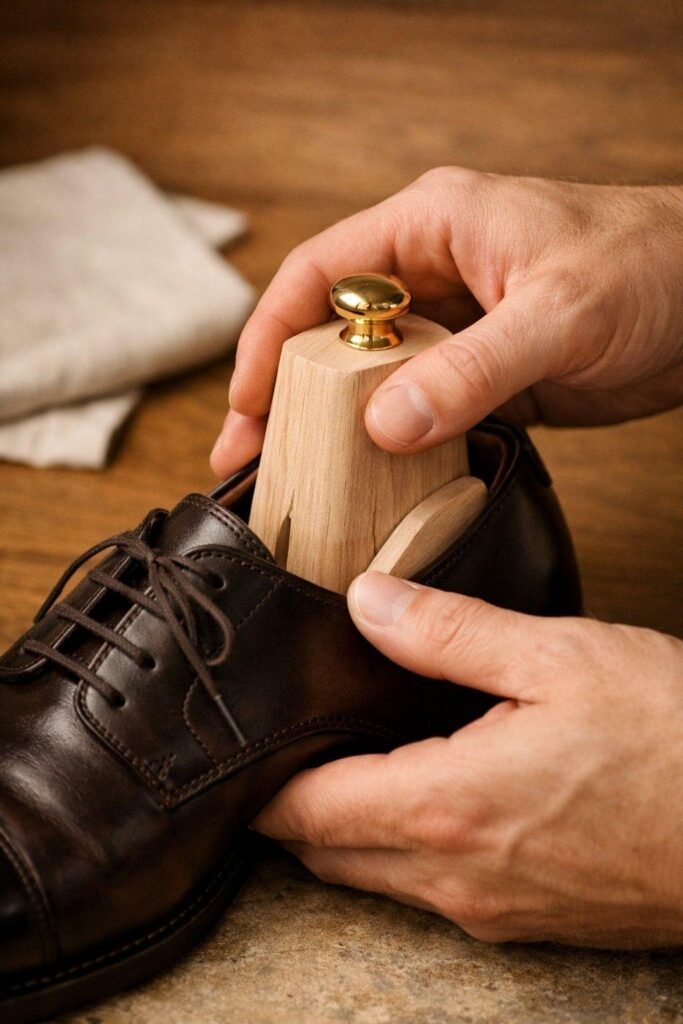
Let shoes breathe 15 to 20 minutes, then seat the heel first and guide the forepart in under gentle tension.
After you take off your shoes, let them breathe 15 to 20 minutes before inserting trees into warm, perspired uppers. Hold the tree by the heel block, compress the toe spring, seat the heel firmly into the counter, then guide the forepart in and release under gentle forward tension. Leave trees in until the next wear; for seasonal storage, keep them in to maintain shape and buffer humidity. To remove, compress the spring, lift the heel out first, and slide the toe block free to avoid scratching the lining. If shoes get rain-soaked, air-dry them two to three hours before inserting trees so the wood doesn’t pull moisture too aggressively from one spot. Refresh cedar every 12 to 18 months with light sanding, and replace trees when heel blocks crack, springs lose tension, or foreparts warp. Pair this with conditioning your leather to keep the uppers healthy between wears.
Common Mistakes to Avoid
- Buying shiny, varnished cedar that can’t absorb moisture because the coating seals the pores
- Forcing oversized trees in, stretching the upper and altering the fit
- Using wire spiral trees in quality shoes, deforming the heel counter over time
- Inserting trees into rain-soaked shoes instead of letting them air-dry first
- Storing shoes long-term without trees, letting heel, toe box, and vamp collapse
- Rotating one pair of trees across many shoes so nothing dries properly
- Treating plastic trees as a daily solution instead of a travel-only one
For the wider kit that supports this routine, see our shoe-care accessories guide.
Frequently Asked Questions
Do I need shoe trees for every pair?
Ideally yes for leather shoes you wear often. If budget is tight, prioritize your most-worn pairs and rotate, leaving trees in each shoe at least 24 hours.
Will cedar trees stretch my shoes?
Correctly sized trees hold shape, not stretch. Oversizing or forcing insertion is what stretches uppers and changes fit.
Can shoe trees remove existing creases?
They soften creases and stop them deepening, but won’t erase deep, long-set folds.
How long do cedar trees last?
With annual light sanding, a lifetime; the wood doesn’t wear out, only the surface needs refreshing.
Should I use trees in sneakers and loafers?
Yes for leather sneakers, and especially loafers, whose slip-on construction makes them prone to toe curl and vamp collapse.
Get in Touch
Spotted a shoe worth examining, want to send a pair in for review, or have a correction? The Bespoke Sole is an independent editorial studio, and I read everything that comes in. Reach the studio here.
Lace up. Zip up. Slip in.