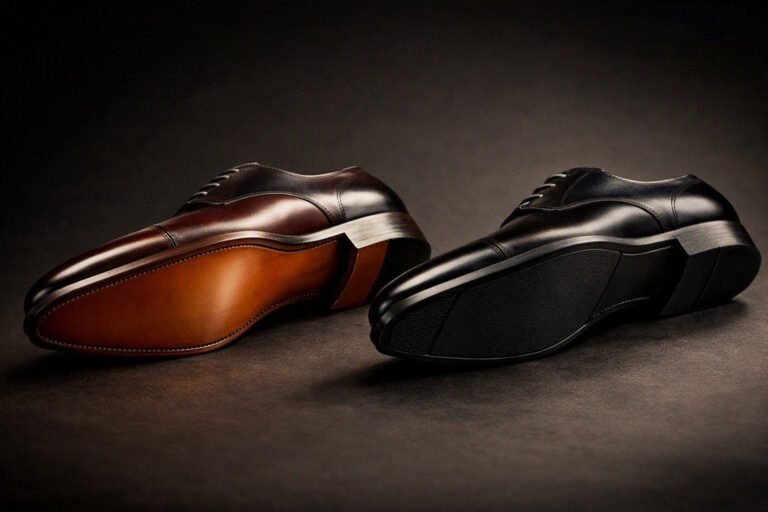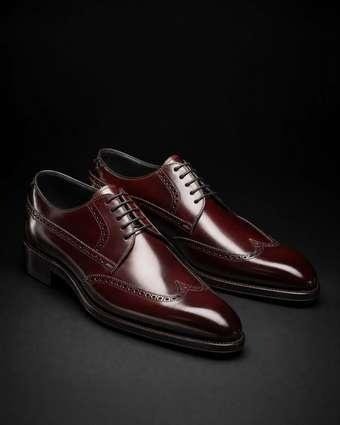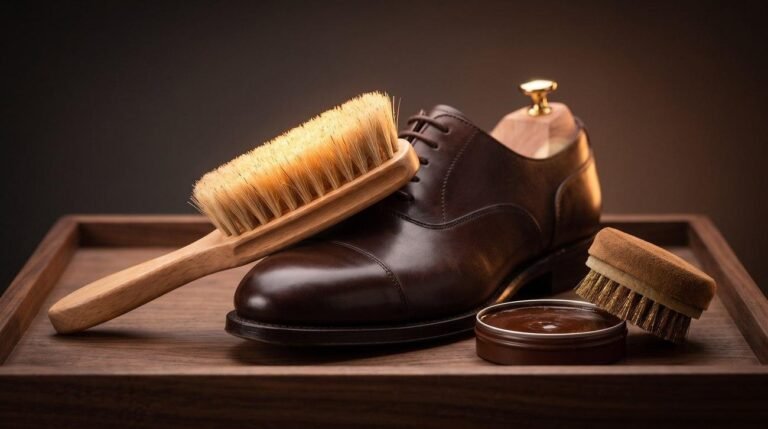
Two very different soles, one honest answer: the right choice depends on where you walk, not on which one looks better in the box.
A beautiful shoe is only as useful as the sole beneath it. The upper may attract the attention, but the outsole decides how the shoe feels on pavement, responds to rain and fits into everyday life. So, which is better: leather or rubber?
The honest answer is that neither material is better in every situation. Leather soles are elegant, slim and traditional; rubber soles offer more dependable grip, weather resistance and day-one flexibility. For many bespoke clients, a leather-and-rubber hybrid is the most sensible choice of all. The right decision depends on where you walk, how often you wear the shoes and how formal you want them to look.
Leather Sole vs Rubber Sole at a Glance
| Consideration | Leather sole | Rubber sole |
| Appearance | Sleek, refined and highly traditional | Ranges from discreet city rubber to rugged tread |
| Initial grip | Can feel smooth until scuffed through wear | Usually more secure from the first wear |
| Wet-weather use | Best kept away from prolonged rain and saturated ground | The more practical choice for wet streets |
| Comfort | Firm at first, then flexes and forms with wear | Flexible and shock-absorbing from the outset |
| Durability | Depends heavily on leather quality, conditions and walking pattern | Usually more resistant to abrasion and repeated wet-weather wear |
| Formality | The classic choice for formal and evening footwear | Suitable for business wear when a slim profile is used |
| Maintenance | Needs drying time and sensible rotation | Generally lower-maintenance |
| Bespoke potential | Allows a very fine edge, sculpted waist and elegant finish | Can be selected in different compounds and tread depths |
| Best suited to | Formal occasions, offices and mostly dry conditions | Commuting, frequent walking and changeable weather |
What Is a Leather Shoe Sole?
A leather shoe sole is an outsole cut from dense leather, often called sole leather, firmer and more compact than upper leather. Quality varies with hide, tanning and fibre density; higher-grade, pit-tanned sole leathers are prized for wear resistance, and a double leather sole adds substance and durability at the cost of weight and stiffness.
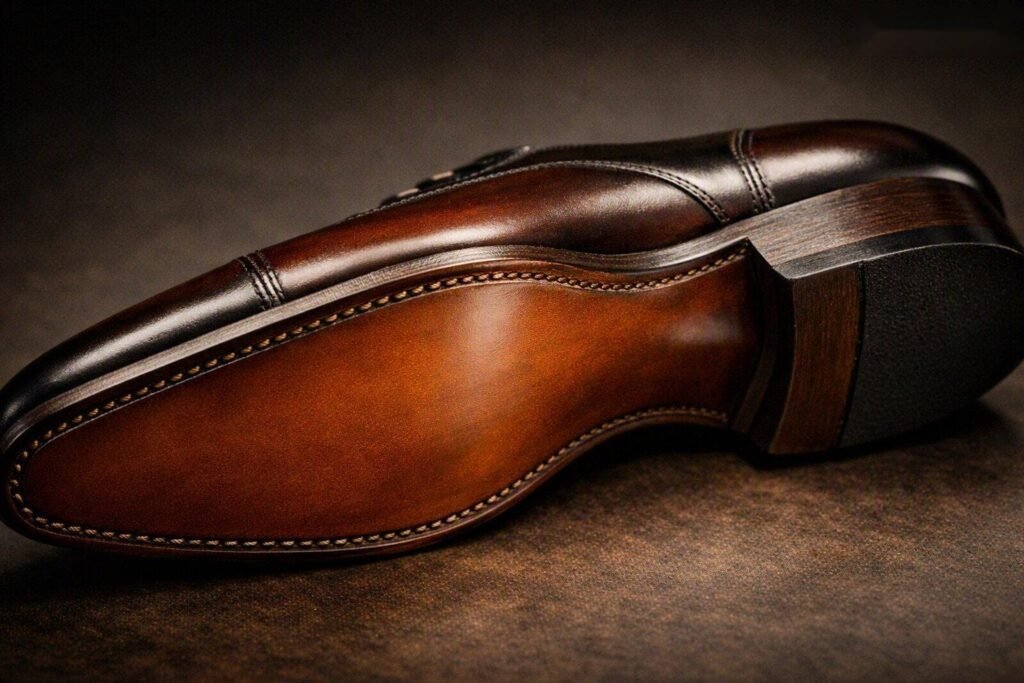
A single leather outsole remains the benchmark for elegant dress shoes because it can be shaped with precision: a close-cut edge, a narrow waist, a clean transition into the heel. Those details matter in bespoke shoemaking, where the underside of the shoe is part of the design rather than an afterthought.
Why Choose Leather Soles?
1. They create the most refined silhouette
Leather can be worked thinner and closer than most rubber alternatives, giving the maker a graceful waist and a discreet sole edge. On an Oxford, wholecut or formal loafer, this makes the shoe look lighter and more balanced, which is why shoes with leather soles stay closely tied to tailoring, eveningwear and traditional shoemaking.
2. They become more personal with wear
A new leather-sole shoe can feel firm, but the sole gradually flexes at the natural bend of the foot as welted layers settle with use, feeling less generic over time. This is not softness: leather lacks the immediate cushioning of foam or flexible rubber, and its appeal develops rather than arriving on day one.
3. They are ideal for formal and indoor settings
For offices, ceremonies, evening events and mostly indoor wear, a leather outsole is hard to improve upon: quiet, unobtrusive, visually appropriate with fine tailoring, and smooth on carpet and finished floors.
4. They offer exceptional finishing possibilities
Bespoke makers can stain, polish and decorate leather soles, conceal the stitching in a closed channel, or shape a sculpted, bevelled waist. These treatments do little for wet-weather performance, but they show the handwork the material allows.
The Drawbacks of Leather Soles
The elegance of leather comes with practical limits. A smooth new sole may feel slippery on polished floors until normal wear abrades the surface, and leather is not the best material for prolonged rain, standing water, road salt or repeated saturation; quality leather tolerates occasional damp if dried correctly, but a different sole is wiser in a downpour. Leather can also wear quickly on someone walking miles daily on rough concrete, with the toe abrading first on a forceful stride; a fitted metal or rubber toe piece can protect that area when needed.
Honest verdict: choose leather for its refinement, not because it is indestructible or suited to every forecast.
Why Choose Rubber Soles?
1. They provide more dependable everyday traction
Rubber usually grips better than smooth leather on wet paving and hard urban surfaces. Tread and compound still matter, so no sole is slip-proof, but rubber is the more reassuring option for commuting and unpredictable weather.
2. They cope better with rain
A rubber outsole does not absorb water the way exposed leather can, making it a more practical barrier against wet pavement. The upper, welt and seams still need care, so rubber doesn’t make a shoe waterproof; it just makes the bottom more resistant to wet conditions.
3. They feel flexible and cushioned sooner
Many rubber compounds flex easily from the first wear and absorb more impact than firm sole leather, which can suit clients who stand for long periods or want less of a break-in period.
4. They offer several levels of formality
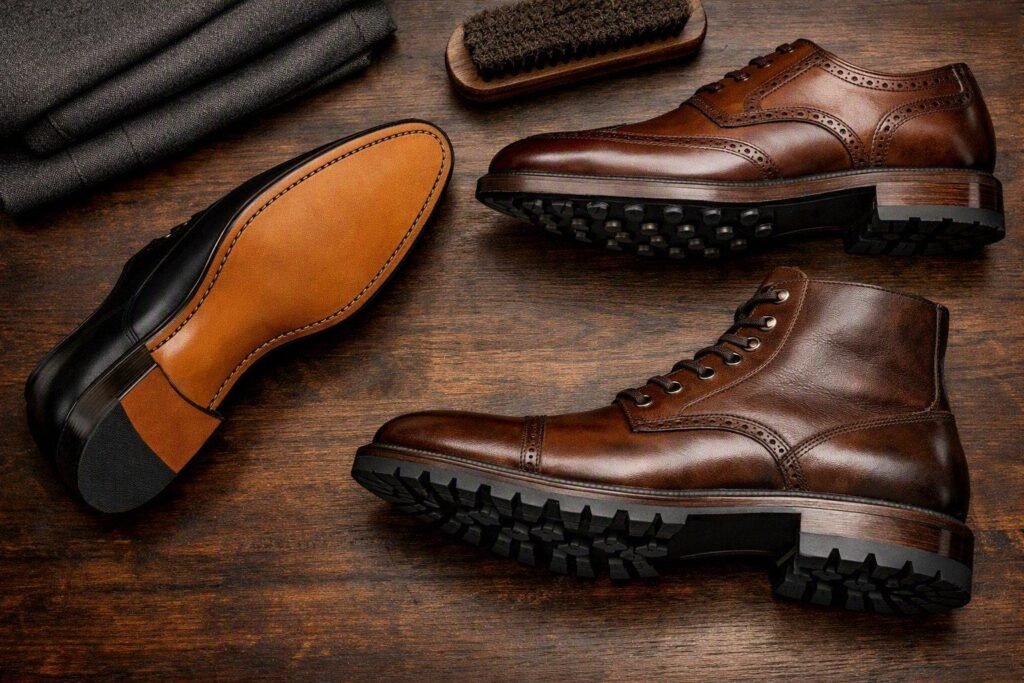
“Rubber sole” does not automatically mean a heavy boot tread. A slim city rubber sole can preserve much of a dress shoe’s profile while improving wet-weather grip; studded rubber suits country and business footwear, and lugged or commando-style rubber gives boots more substance and traction on uneven ground.
The Drawbacks of Rubber Soles
Rubber is practical, but not aesthetically neutral. A thick sole or deep tread adds visual weight and can make a formal shoe look casual, and even slim rubber cannot usually match the delicacy of a fine leather sole. Feel also varies: a soft compound is comfortable but wears faster, while a hard compound lasts longer but feels less forgiving in cold conditions, and tread alone does not guarantee grip.
Rubber also offers less of the traditional patina and finishing of a bespoke leather outsole; it is usually chosen for function first, even when the design is discreet.
Which Sole Is More Comfortable?
Comfort depends on more than the outsole: last shape, fit, arch support, heel height and gait all matter more than a simple leather-versus-rubber label. Leather generally feels firmer and needs several wears to flex naturally, with a stable, close-to-the-ground sensation; rubber feels softer and more flexible immediately, suiting a long commute or a day on hard floors. In bespoke footwear, comfort should be specified as a system: a client who wants a formal look but needs more shock absorption may prefer a slim rubber outsole or a discreet rubber insert over a heavy tread.
Which Sole Lasts Longer?
Under comparable conditions, rubber usually resists abrasion and wet weather better than leather, though a thin, soft rubber compound can wear quickly, while dense, high-quality sole leather performs well in dry conditions with rest between uses. Your walking environment matters as much as the material: rough pavements, long distances, a pronounced toe strike and daily wear of the same pair all accelerate wear, and rotation helps by letting the shoe dry fully between outings.
Inspect the outsole rather than waiting for a hole to appear. When the centre thins, the stitching is at risk or the heel wears unevenly, ask a skilled repairer before damage spreads into the welt or upper.
Are Leather Soles Slippery?
A new polished leather sole can be smooth, but a short period of normal outdoor wear creates texture and improves traction on dry ground; deliberately attacking a new sole with a knife or coarse tool is unnecessary and can damage it.
Even after breaking in, leather remains less dependable than suitable rubber on wet tile, metal grates and slick pavement. On ice, both materials require caution, since compound and tread pattern become critical, and no dress-shoe outsole should be treated as a guarantee against slipping.
If traction matters but you still want the look of leather, consider a thin rubber forepart applied by the maker or an experienced cobbler.
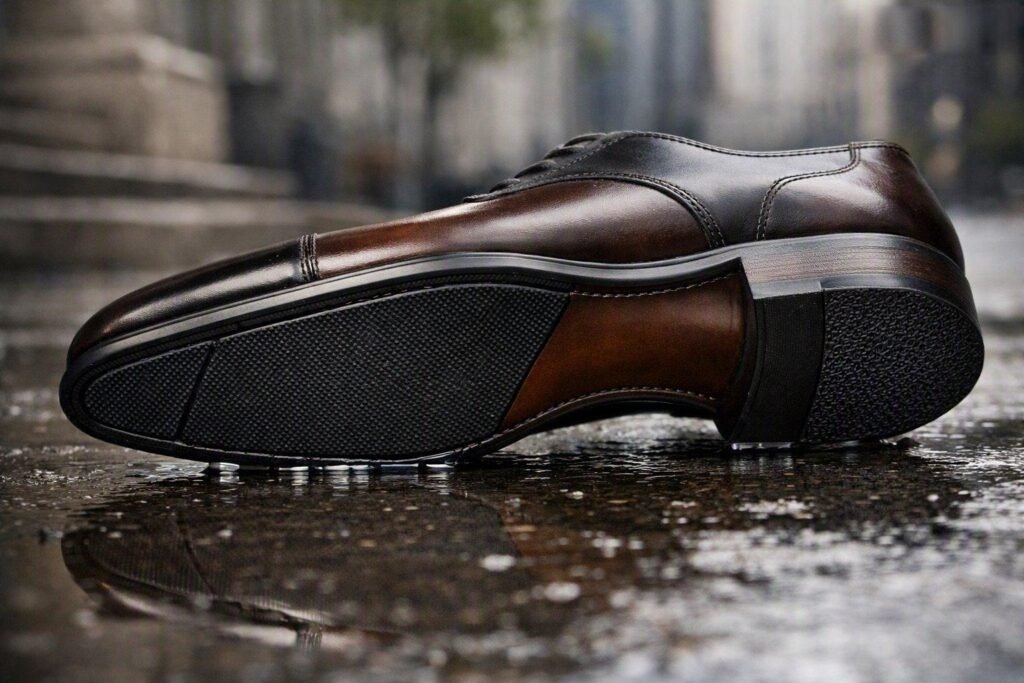
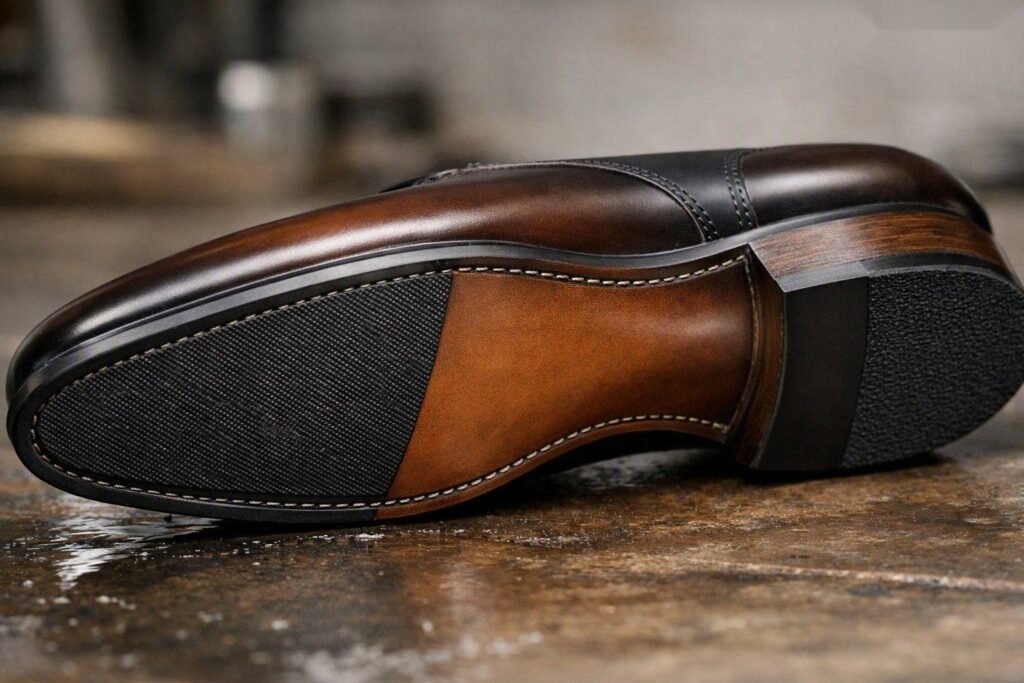
The Hybrid Option: Leather with a Rubber Forepart
A hybrid sole places a discreet rubber layer or insert beneath the forepart while keeping leather through the waist and, depending on design, around the visible edge. Sometimes called a half-rubber sole or rubber sole protector, it offers better grip where the forefoot meets the ground, protection for the highest-wear area, and much of the look of a traditional leather sole. Thin rubber protectors are now used even by some bespoke makers, pairing hand-stitched construction with everyday practicality.
There is a trade-off: the shoe loses some of the pure feel of an all-leather outsole, and application matters, since poor preparation or excessive sanding can compromise the result. For many clients, though, the hybrid is not a second-best answer. It is the most rational specification.
How to Choose the Right Sole for Bespoke Shoes
Begin with your real routine, not an idealised one.
| If this describes you… | Consider… |
| You mainly wear the shoes indoors or to formal events | A single leather sole |
| You want a more substantial traditional shoe | A double leather or HAF-style sole |
| You commute on foot in frequent rain | A slim full-rubber or studded rubber sole |
| You want elegance with better grip at the forefoot | A leather sole with a thin rubber protector |
| You need boots for uneven paths or country use | A lugged, ridge or commando-style rubber sole |
| You rotate several pairs and mostly walk in dry conditions | Leather is a practical option |
| This will be your one pair for daily, all-weather wear | Rubber is likely the better investment |
A bespoke consultation should also weigh the visual weight of the upper: a fine black Oxford usually suits a close-cut leather or slim city sole, a country brogue can carry a double sole or studded rubber, and a robust boot can take deeper tread without looking unbalanced.
Caring for Leather and Rubber Soles
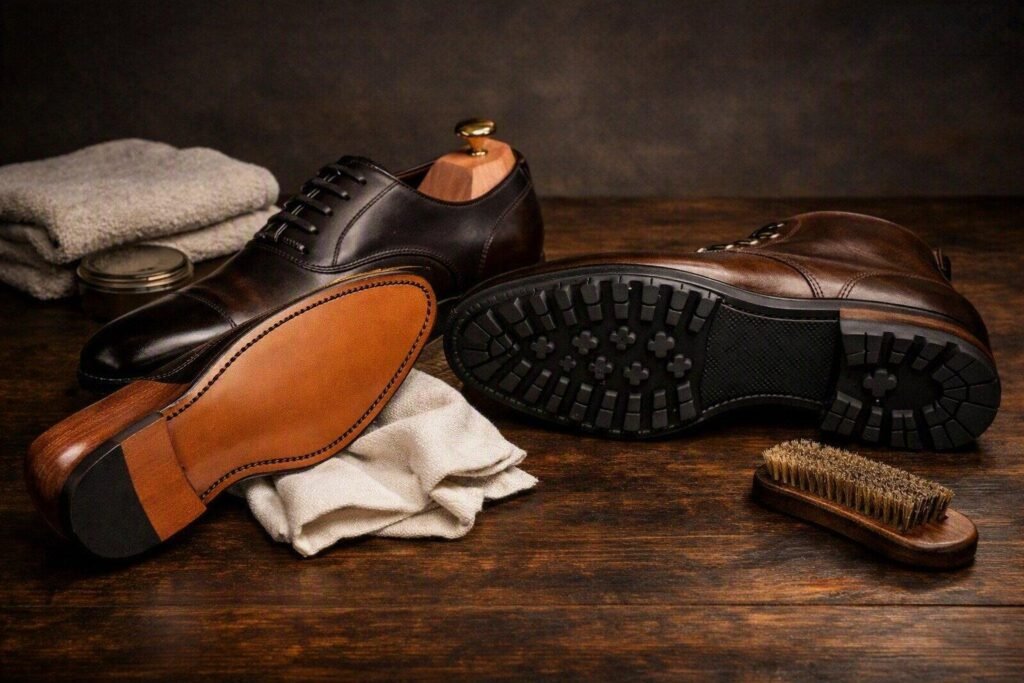
Let wet leather soles dry slowly at room temperature, never against a radiator or other concentrated heat, which can harden and distort leather. Insert shoe trees, wipe away dirt and let the pair dry fully before wearing it again, and avoid ordinary upper-leather cream on the walking surface unless the maker recommends it. Most importantly, rotate your shoes and check the toe, centre and heel regularly for uneven wear.
Rubber needs less attention but should still be cleaned: remove embedded stones from the tread, brush away mud once it dries, and inspect the edge for separation and the heel for uneven wear. Replace a worn heel top piece before wear reaches the stacked heel or other structural components.
The sole is only part of the picture. For a new pair, see our guide to conditioning vs. polish for new leather shoes before the first wear.
The Final Verdict
Choose leather soles if refinement, tradition and a slim formal profile are your priorities; they are at their best in dry conditions, controlled indoor settings and a considered rotation. Choose rubber if you expect regular rain, long walks, hard pavements or immediate traction: a well-selected low-profile rubber outsole can stay smart enough for business dress while being easier to live with every day. Choose a hybrid if you want the craftsmanship and elegance of a leather sole with extra protection at the forefoot.
The best bespoke sole is not the one with the grandest reputation. It is the one designed honestly around the life you will ask it to lead.
Frequently Asked Questions
Are leather soles better than rubber soles?
Leather soles are better for a sleek, traditional and highly formal appearance. Rubber soles are generally better for wet weather, frequent outdoor walking and immediate grip. The better choice depends on how and where the shoes will be worn.
Can you wear leather-soled shoes in the rain?
Occasional damp ground is not necessarily disastrous for a quality leather outsole, provided the shoe is allowed to dry slowly and fully. Prolonged rain, puddles and repeated saturation will shorten its life. Choose rubber when heavy rain is expected.
Do leather soles become less slippery?
Yes, normal wear roughens the polished surface and improves dry-ground traction. They can still be slippery on wet tile, metal and other smooth surfaces, so they will not match the dependable grip of an appropriate rubber compound.
Can rubber be added to a leather sole?
Yes. A skilled maker or cobbler can fit a thin rubber protector to the forepart of many leather soles. This can improve grip and abrasion resistance while retaining leather at the waist and around much of the sole.
Is a leather outsole suitable for everyday wear?
It can be, especially in a dry climate and as part of a rotation. For a single pair worn daily through rain and long urban walks, rubber is usually the more practical specification.
Can bespoke shoes be resoled?
Many stitched constructions are designed to permit resoling, but the method and number of possible repairs depend on the construction (Goodyear welt vs. Blake stitch age very differently), condition and skill of the repairer. Arrange an assessment before wear reaches the welt or upper.
Lace up. Zip up. Slip in.