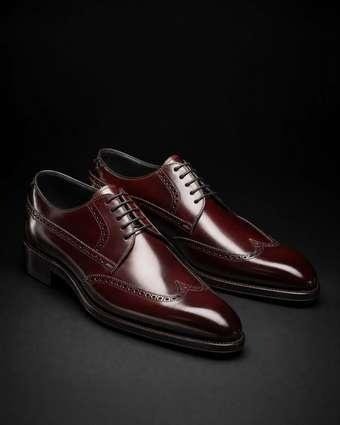
You found two gorgeous derbies. Same leather, same price, nearly identical lines. One tag says “Goodyear welted.” The other says “Blake stitched.” The shop assistant just shrugs.
Now you stand there, wallet open, wondering which pair will still look sharp in ten years. I get this question constantly. So let me break it down for you.
In this piece, I explain what each construction actually is, why the difference matters, and how each one wears over time. We will cover the build, the resole math, the weather problem, and a quick table you can screenshot. Then I tell you, plainly, which one ages better and when to pick each. No brand worship here. Just the seams.
What Is A Goodyear Welt?
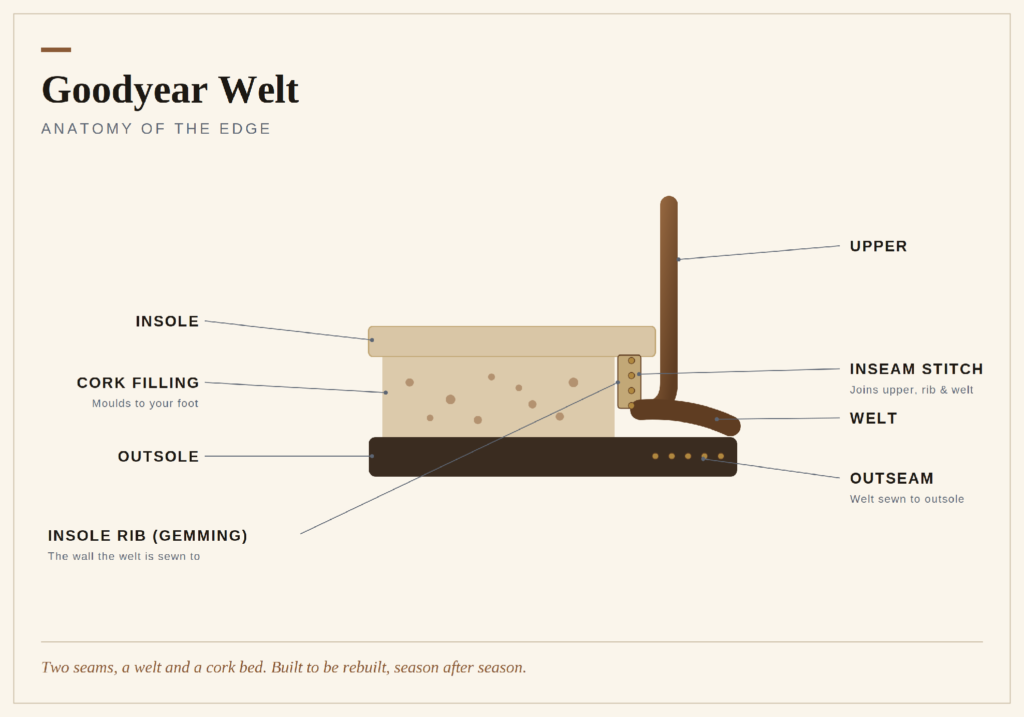
Picture a thin leather strip running around the bottom edge of the shoe. That strip is the welt. First, the maker stitches it to the upper and to a ribbed insole. Then a second row of stitching joins the outsole to that welt.
So you get two seams doing two separate jobs. Meanwhile, the hidden cavity between insole and outsole gets packed with cork. That cork molds to your foot over time. It also creates a small moisture barrier.
This is the classic British and American workhorse method. Think Northampton. Think dress boots built to survive real winters.
What Is A Blake Stitch?
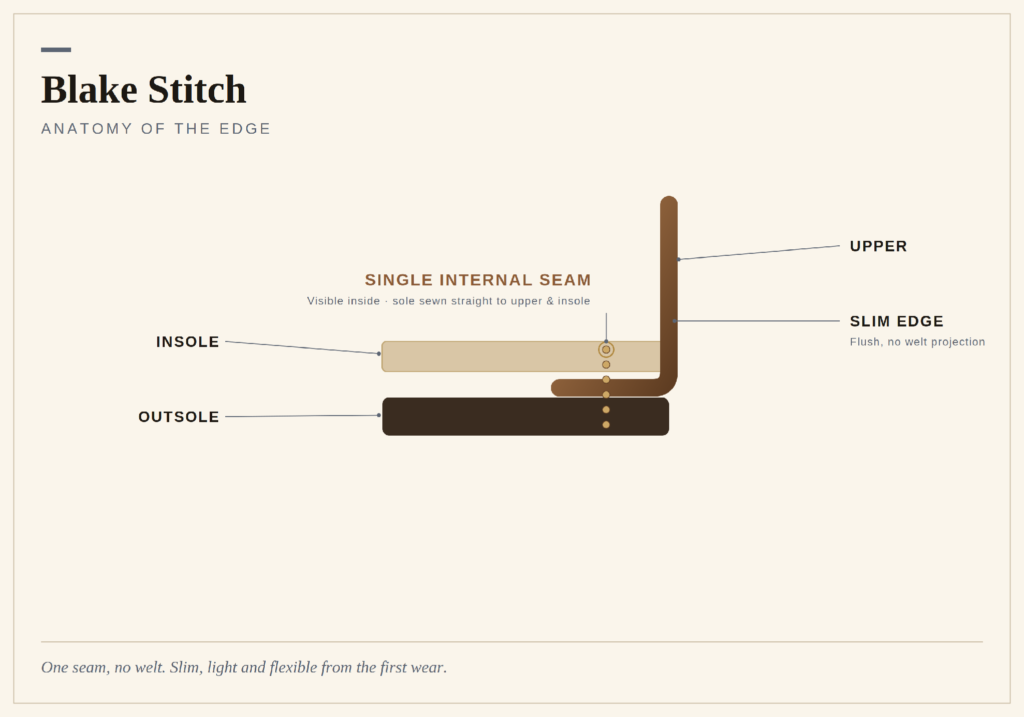
Blake construction skips the welt entirely. Instead, a single row of stitching passes straight through the outsole, the insole, and the upper. Lyman Blake patented the machine for this back in 1856.
Because no welt sits in the way, the sole hugs the upper closely. As a result, the shoe feels slimmer, lighter, and more flexible right away. You notice less bulk under your foot.
The catch? That seam lives inside the shoe. You can actually see it near the insole. Italian makers love this method for sleek, elegant silhouettes.
How Are They Actually Built?
Here is the short version, step by step.
Goodyear welt:
- The insole gets a rib, either sewn or formed through gemming.
- The welt stitches to that rib and the upper.
- Cork fills the cavity for cushioning.
- The outsole stitches to the welt, never touching your foot directly.
Blake stitch:
- The upper wraps the last and the insole.
- One machine drives a single seam through sole, insole, and upper.
- That stitch stays exposed on the insole side.
- Trimming pulls the sole in tight and clean.
Goodyear Welt vs Blake Stitch: The Quick Comparison
| Feature | Goodyear Welt | Blake Stitch |
|---|---|---|
| Seams | Two rows of stitching | One internal row |
| Weight | Heavier, more structured | Lighter, sleeker |
| Flexibility | Stiffer, longer break-in | Flexible out of the box |
| Water resistance | Stronger, welt shields seam | Weaker, exposed inner seam |
| Resoles | Five to ten plus | Fewer in practice |
| Best for | Boots, bad weather, daily abuse | Dress shoes, dry climates |
Which One Actually Ages Better?
Now the real question. Both age well with good leather and basic care. However, they age differently, and one tolerates a rough life far better.
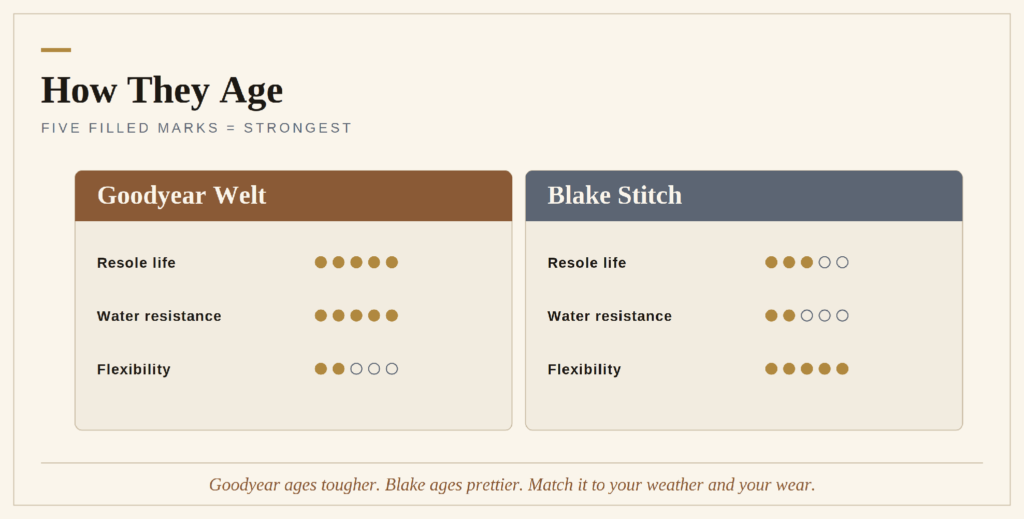
Goodyear welted shoes win on pure longevity. You can resole them many times, often five to ten rounds or more. Over the years, the cork molds, the upper builds patina, and the welt shields the main seam from rain.
Blake stitched shoes age gracefully too, especially in dry climates. The slim sole and soft flex stay elegant for years. Yet that exposed internal seam lets water creep in more easily. Repeated resoling also thins the sole stack faster.
So if you pound wet city streets daily, Goodyear holds up longer. On the other hand, if you baby your shoes and stay mostly indoors, Blake keeps its charm beautifully.
When Should You Choose Each?
Choose a Goodyear welt when you want boots, bad-weather shoes, or a pair you plan to keep for a decade or two. It rewards heavy use and frequent cobbler visits.
Choose a Blake stitch when you want a lighter dress shoe, a closer-trimmed profile, or that sleek Italian look. It suits drier weather and a gentler routine.
Honestly, your habits matter more than the marketing copy. Match the construction to your life, not your ego.
TL;DR
| Goodyear welt uses a welt strip and two seams, so it resists water and resoles many times. Blake stitch uses one internal seam, so it stays slim, light, and flexible. In short, Goodyear ages tougher, while Blake ages prettier. Choose by weather and wear, not by brand name. |
Conclusion
Both methods are real craft, and neither is a gimmick. Goodyear gives you a fortress you can rebuild again and again. Blake gives you elegance and feel with a slimmer footprint.
If longevity through hard wear is your goal, lean Goodyear. If refined lines and easy flex matter most, lean Blake. Either way, buy good leather, brush often, and rotate your pairs. Construction sets the ceiling. Your care decides how close you get to it.
Frequently Asked Questions
Can You Resole A Blake Stitched Shoe?
Yes, you can. Any cobbler with a Blake machine can handle it. Without that machine, though, they may just stitch and glue, which is less ideal. So always ask first.
Is Goodyear Welt Always Better Than Blake?
No. “Better” depends entirely on your needs. Goodyear lasts longer through abuse. Blake feels lighter and looks sleeker. Different jobs, different winners.
Which Construction Is More Waterproof?
Goodyear welt resists water better. The welt and cork add a real barrier. Blake’s exposed internal seam, by contrast, lets moisture in more easily.
How Can I Tell Which One I Own?
Flip the shoe over. A welt strip running around the edge with two stitch rows means Goodyear. A single stitch line near the sole edge usually means Blake.
| WANT THE TRUTH BEFORE YOU BUY? I take luxury shoes apart with my eyes, seam by seam, so you never waste money on a cemented sole priced like hand welting. No brand pays me, and no house gets a pass.READ THE REVIEWS → |