Construction is not the same thing as material. A leather outsole can be fitted to a hand-welted, Goodyear-welted, Blake-stitched, Bologna, Norvegese, or cemented shoe — the word describes how the upper, insole, welt, and outsole are joined, not what the sole is made of. That distinction matters, because construction is what actually governs profile, flexibility, weather resistance, repairability, and price. No amount of fine leather compensates for the wrong construction, and no construction compensates for a poor last or careless fit.
Below are the seven constructions worth knowing, in plain terms, with the trade-offs stated rather than glossed over. None of these is “the best.” Each is the right answer for a different shoe.
| Technique | Character | Best suited to | Principal compromise |
| Hand-welted | Highly crafted, durable, potentially very refined | Bespoke and top-tier Oxfords, Derbies, monk straps, and boots | High labor and cost |
| Cemented | Light, thin, and easy to shape | Sleek loafers, wholecuts, evening shoes, and fashion-led footwear | Usually less straightforward to resole |
| Bologna / sacchetto | Soft, flexible, slipper-like | Unstructured loafers and lightweight summer dress shoes | Less structure and support |
| Norvegese | Robust, weather-oriented, visually expressive | Country Derbies, substantial shoes, and boots | More weight, bulk, stiffness, and expense |
| Blake-stitched | Slim, light, and flexible | Elegant Italian-style Oxfords, wholecuts, and loafers | Specialist equipment is normally needed for resoling |
| Goodyear-welted | Structured, durable, readily repairable | Business shoes, all-purpose dress shoes, country shoes, and boots | More layers and a firmer initial feel |
| Closed-channel stitching | Clean, formal sole finish | Refined welted or Blake-stitched dress shoes | Mainly aesthetic; the covering flap can be damaged in hard wear |
A note on the illustrations below: these are simplified conceptual diagrams, not literal technical cross-sections. Construction details vary by maker — read them as visual guides, not blueprints.
1. Hand-Welted Construction
In a hand-welted shoe, the maker cuts a holdfast — a raised rib — directly into a thick leather insole, then hand-stitches the upper, lining, and leather welt to that holdfast. A second seam, sewn by hand or machine, joins the outsole to the welt. Unlike Goodyear construction, hand welting has no separate canvas rib glued to the insole, which gives the maker far more control over the shape: a close-cut edge and a finely sculpted waist stay possible without giving up repairability.
Hand welting is not automatically more comfortable than a well-made Goodyear shoe — fit, last design, and internal structure still matter more than the seam. What it buys you is craftsmanship, refinement, and a shoe built to be resoled for decades.
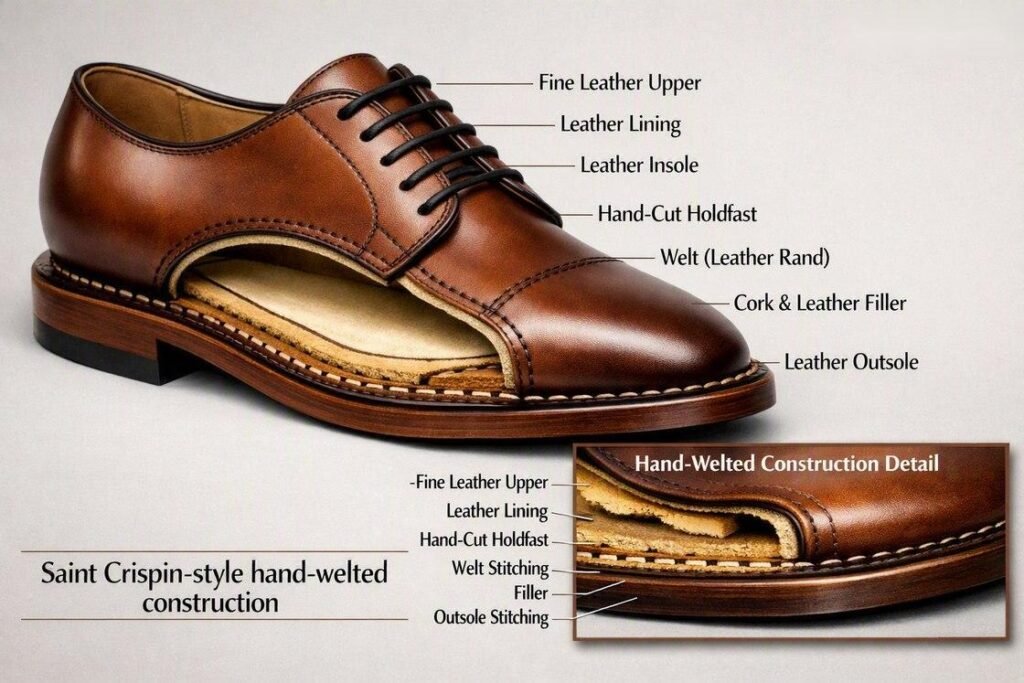
Note: the “holdfast” shown here is a rib the maker cuts directly into the leather insole, not a separate part — and the exact filler and outsole-stitching arrangement varies by maker.
Best for: bespoke or top-tier ready-to-wear Oxfords, Derbies, monk straps, and dress boots — when craftsmanship and a long service life justify the price.
2. Cemented Construction
In cemented construction, the lasted upper is bonded straight to the outsole with adhesive — no structural welt, no through-stitch. That’s what allows the thin edge, low weight, and immediate flexibility that make cemented shoes feel almost weightless out of the box. A luxury cemented shoe can still use excellent upper leather and finishing; “cemented” isn’t shorthand for “cheap.” The real limitation is resoling — it’s less standardized and often less economical than resoling a welted shoe, and results depend heavily on the repairer’s skill.
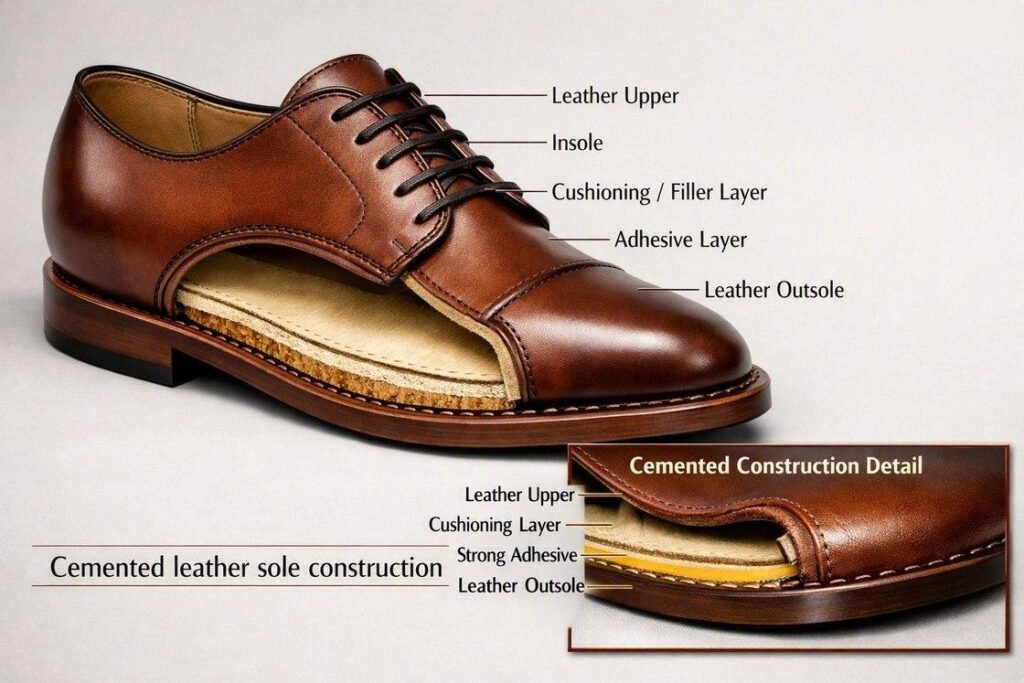
Note: adhesive, not stitching, secures a true cemented outsole — the perimeter line in this diagram is decorative, not a structural seam.
Best for: sleek loafers, wholecuts, opera pumps, and fashion-led dress shoes worn in relatively dry, urban conditions — where lightness and a clean profile matter more than repeated resoling.
3. Bologna, or Sacchetto, Construction
Bologna — also called sacchetto, Italian for “little bag” — builds a soft, tubular interior by stitching the lining into a flexible sock around the foot. In the forepart, that lining assembly replaces the rigid insole structure found in most dress shoes, which is what gives Bologna shoes their close, glove-like feel. Bologna doesn’t specify how the outsole itself is attached; depending on the maker, that can be Blake stitching, another stitched system, or adhesive. It’s better understood as a way of building the shoe’s flexible interior than as one single outsole seam.
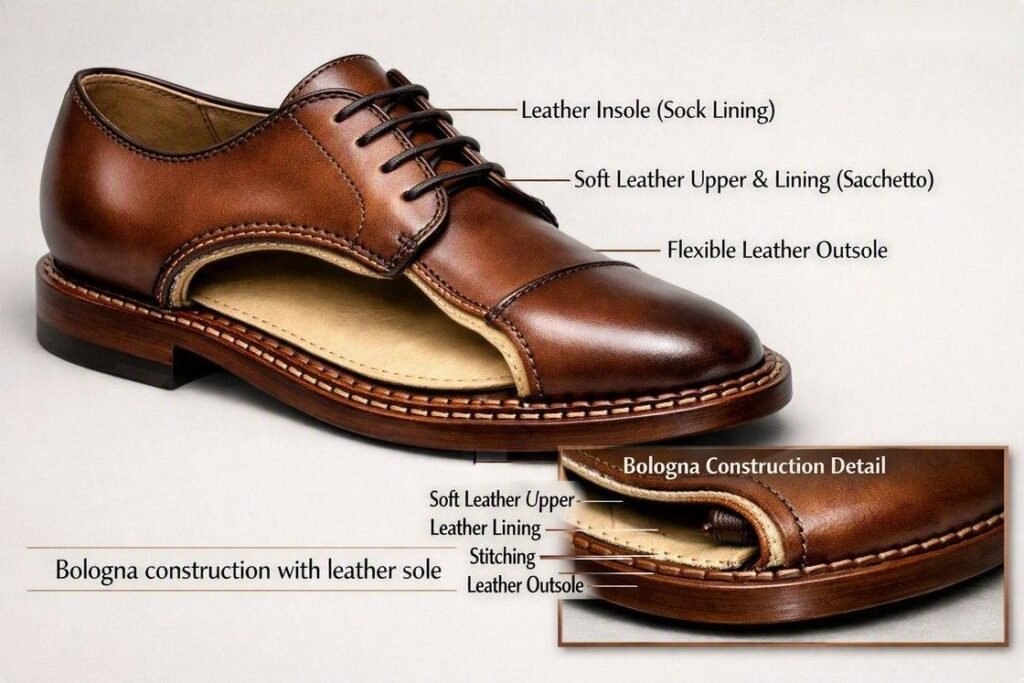
Note: this diagram shows one possible Bologna build. The outsole can equally be attached by Blake stitching or cement depending on the maker, and the sacchetto “sock” lining shown here is not the same thing as a rigid structural insole.
Best for: soft loafers, lightweight Derbies, travel shoes, and warm-weather dress shoes that favor supple leathers and light soles over arch structure or weatherproofing.
4. Norvegese, or Norwegian, Construction
Norvegese covers a family of robust constructions in which the lower edge of the upper is turned outward and the structural stitching is displayed prominently around the shoe rather than hidden. Details vary by maker: some use a separate welt, others stitch through the turned-out upper and intermediate sole components in a different sequence. The broad edge and multiple visible seams protect the sole junction and give Norvegese its characteristic hand-made look.
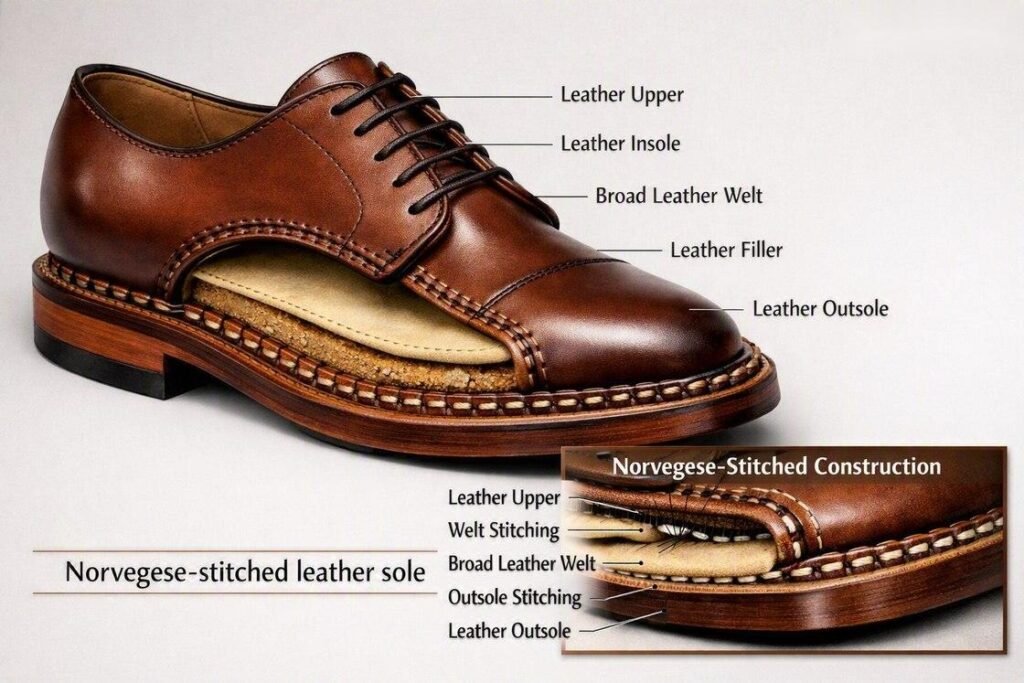
Note: Norvegese methods vary by maker — a broad separate welt, and the exact number and route of the stitches, are not universal to every Norvegese shoe.
Best for: substantial Derbies, split-toe shoes, country shoes, and boots in textured calf, grain leather, or suede — damp or cold conditions, and a bold, artisanal look.
Check out the Santoni Norvegese Derby review
5. Blake-Stitched Construction
A Blake seam runs from inside the shoe through the insole, upper margin, and outsole, joining all three directly with no welt in between. Fewer layers at the edge means the shoe can be slim, light, close-cut, and flexible — which is a large part of why Blake construction is so closely associated with elegant Italian footwear. The trade-off is that the direct seam puts less material between foot and ground than a welted build, and water can reach the stitch line more easily, so Blake suits normal urban wear better than prolonged wet weather. Resoling is possible, but the repairer typically needs a Blake stitching machine.
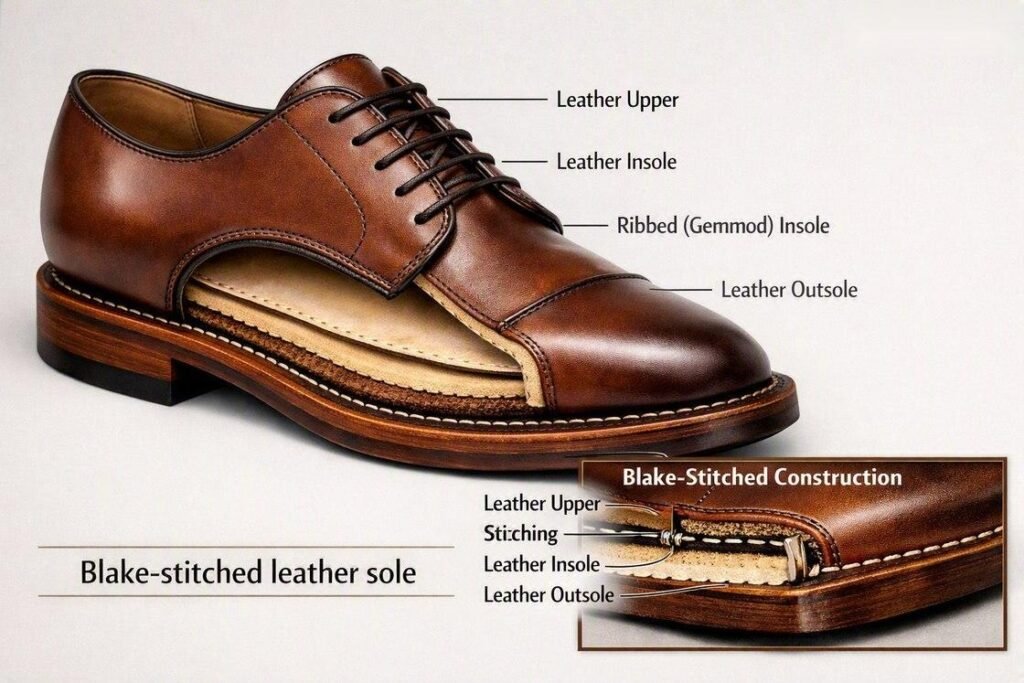
Note: this stock diagram labels a “ribbed (gemmed) insole,” which is a Goodyear-welt feature. A genuine Blake insole has no gemming rib — the seam passes straight through insole, upper, and outsole.
Best for: refined Oxfords, wholecuts, and loafers whose design depends on a narrow sole edge and a supple forefoot — indoor, office, evening, and warm-weather wear.
Read out Goodyear Welt vs Blake Stitch: Which One Actually Ages Better?
6. Goodyear-Welted Construction
In Goodyear construction, a machine stitches the upper, lining, and leather welt to a rib attached to the insole. The cavity beneath the foot is filled — often with cork — and the outsole is stitched to the welt in a separate operation. Because that outsole seam never passes through the upper, a repairer can pull and replace the sole without disturbing the upper at all, which is the whole case for Goodyear welting’s reputation as the practical, business-first construction. It’s usually firmer underfoot at first than Blake, though sole thickness and last design change that a great deal. “Goodyear-welted” doesn’t mean hand-made — the defining welt seam is machine-sewn by design.
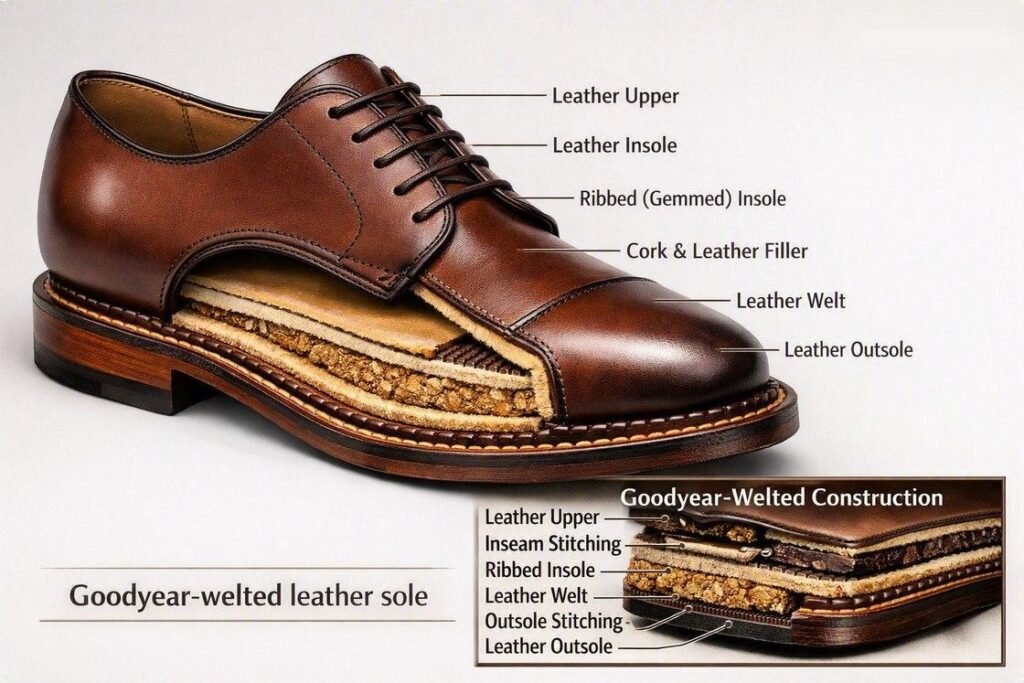
Note: a Goodyear welt improves water resistance at the sole seam — it is not a fully waterproof construction.
Best for: business Oxfords, Derbies, brogues, monk straps, country shoes, and dress or service boots. Pair it with a single leather sole for formal use, a double leather sole for substance, or a discreet rubber sole for wet-weather practicality.
Read our The Architecture of the Perfect Last
7. Closed-Channel Stitching on a Welted Leather Sole
The accurate name for this finish is a welted leather sole with closed-channel outsole stitching — it isn’t a separate way of attaching the upper, but a way of concealing the seam that joins the outsole to the welt. (Closed channels can be used on Blake-stitched soles too.) The maker cuts and lifts a thin flap in the underside of the leather outsole, stitches beneath it, then glues the flap back down. The result is a smooth, uninterrupted sole face and a protected stitch line. It signals extra finishing work, but it doesn’t make the underlying construction stronger or easier to resole.
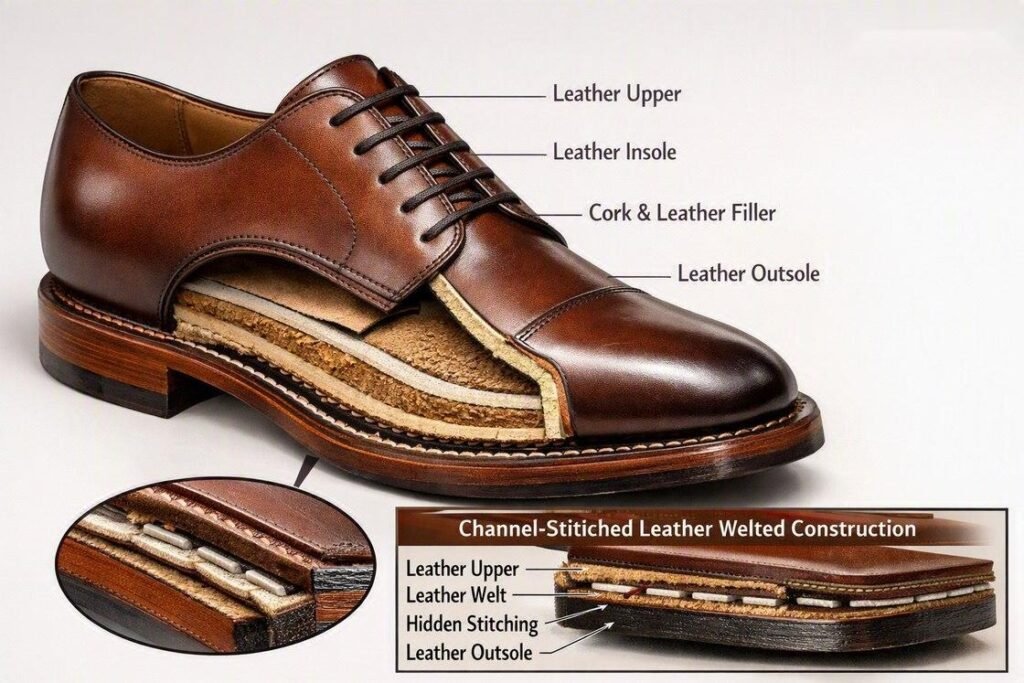
Note: the concealed stitching actually runs in a channel cut into the underside of the outsole — not suspended between the welt and sole the way this diagram shows it.
Best for: high-grade Oxfords, wholecuts, and bespoke dress shoes where sole-face refinement matters. It offers little practical benefit on rugged footwear, and rough or persistently wet surfaces can loosen the thin covering flap.
Sole Materials, at a Glance
Construction is the frame; the outsole material is what actually meets the pavement. Three worth knowing:
Studded rubber (Dainite and similar)
Dainite — the best-known studded rubber sole — has been made by England’s Harboro Rubber Company since 1910. Its self-cleaning tread pattern sheds mud and grit better than a smooth leather sole while reading far more formal than a chunky lug sole, which is why it shows up on business and country shoes that need to survive a commute in bad weather without looking like a hiking boot. Grip is moderate, not aggressive — for genuinely rough terrain, a lugged sole like Vibram outperforms it.
Cork nitrile
Cork nitrile blends roughly 20–40% cork with nitrile rubber, giving a sole that’s durable and notably oil- and chemical-resistant, with poor traction on ice being its main weakness. It’s closely associated with rugged American work boots, though the association has shifted: Red Wing moved its Iron Ranger away from cork nitrile to a Vibram Mini-Lug sole in 2017. Alden’s Indy 403 is a more accurate present-day example of a cork-nitrile sole done well.
Crepe rubber
Crepe rubber is soft, natural, and immediately comfortable underfoot — the trade-off is that it stains and wears faster than harder rubber or leather. It’s the sole most associated with the Clarks Desert Boot, and it belongs on casual, low-mileage shoes rather than anything expected to survive daily commuting.
Choosing the Right Construction
For maximum refinement in a formal shoe, choose hand-welted construction, or a finely executed Goodyear welt finished with closed-channel stitching. For a slim, flexible Italian profile, choose Blake. For slipper-like softness, choose Bologna. For a weather-oriented boot or an assertive country shoe, choose Norvegese. For a light, sharply shaped shoe meant for moderate use, cemented construction is entirely appropriate — not a compromise.
The best construction isn’t the most elaborate one. It’s the one that matches the shoe’s purpose, your climate, the silhouette you want, and whether you intend to have it resoled a decade from now or replaced in three years.
Frequently Asked Questions
Which sole construction lasts the longest?
Hand-welted and Goodyear-welted shoes are built to be resoled repeatedly, often across decades, because the outsole seam never runs through the upper. Cemented and Blake-stitched shoes can be resoled too, but less economically and less predictably.
Is Blake stitching bad for wet weather?
Not bad — limited. The direct seam gives water an easier path to the stitch line than a welted shoe does, so Blake construction is better suited to normal urban wear than to standing water or heavy, prolonged rain.
Can a cemented shoe be resoled?
Sometimes, but it’s less standardized than resoling a welted shoe, and the outcome depends heavily on the original design and the repairer’s skill. Most cemented dress shoes are better budgeted as wear-then-replace rather than resole-forever.
What’s the real difference between Goodyear welt and Norvegese construction?
Both are durable, but Goodyear conceals its structure for a clean, business-formal look, while Norvegese displays its stitching openly for a heavier, more artisanal appearance suited to country and casual wear.
Lace up. Zip up. Slip in.
The Bespoke Sole